Currently Empty: £0.00

functional (& dysfunctional patterns)
My Journey Through Hypermobility, Hip Replacement, and Learning to Walk Again
If you live with chronic pain or a condition that seems to have no clear medical roadmap, you know the feeling. You’ve probably muttered the word “unfair” more times than you can count. I know I have. I’ve reconciled to my reality of hypermobility (unfair) and the lack of a medical protocol for hypermobility (very unfair). It’s easy to feel defeated when your own body betrays you.
But my focus remains on just getting on with it: keeping living fully, joyfully, and working through the present problem. Because no matter how dark the chronic pain journey gets, there is always a path forward, even if it means completely relearning how to use your own body.
The Breaking Point and a Titanium Solution
Let’s talk about the problem. Last year, I had a full hip replacement. It was the ultimate way I worked through the issue of my arthritic right hip. It was a joint so worn down by over-bendy-ness, instability, and dysfunctional patterns of movement that the cartilage had completely worn away.
Surgery was just the beginning. Since then, I’ve been exploring one-on-one with a personal trainer (yes—££) how to walk again. Properly. I’ve been learning to use muscles along the posterior back chain in a way I’d never tried or considered. Owning the reality that I need help with basic body mechanics has helped me accept the expense of these sessions. I don’t see it as a luxury anymore; I consider it an investment in my future comfort, stability, load-bearing, and ultimately, my ability to keep hiking and experience the joy it always gives me.
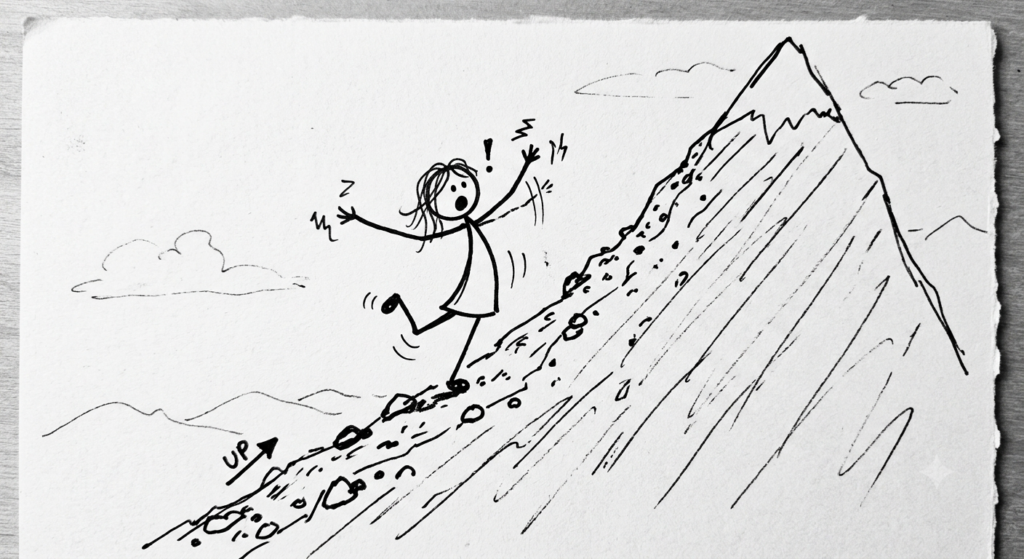
All things come down to this: can I make it up that mountain and get back down again? And enjoy the movement?
Waking Up the Sleeping Muscles with Functional Patterns
Training in Functional Patterns is where I need to be to wake up muscles that have been asleep for so long that my brain can’t even sense their presence. We hypermobile folks have poor proprioception. But it turns out we can change this, bit by bit.
I go through these sessions with my incredibly patient trainer, Carmen. She has heard me say, *”I’m so sorry, I just can’t feel that muscle”* too often, until one day, I finally could not only feel it exists, but actually wake it up and make it work.
Here is the best part for anyone struggling with chronic illness or fatigue: a person doesn’t need to be physically strong to do this. Some days, I’m feeling too weary to do anything but mat exercises—days when gravity has beaten me. But all I have to do is show up to class to get the benefit. The mere mind-muscle connection, once established and repeated, is enough to get my limbs and core moving more efficiently and with less pain.
The Practical Magic of the Mind-Muscle Connection
This is the Functional Pattern: mind and body connection, with every movement and every intention. It’s a truth that goes far beyond physical fitness.
If you are looking for a practical tip to take away today, start small. Don’t force a heavy workout when your body is screaming in pain. Just show up. Lie on a mat and focus your mind on a single muscle group you normally can’t feel. The brain’s ability to adapt means that simply focusing your intention on a muscle can begin to rewire your nervous system. It’s not about lifting the heaviest weight; it’s about re-establishing the pathway from your brain to your body.
I think about how fortunate I am to explore this method and feel the benefits. I would advocate it for anyone needing physical rehabilitation, post-operative physio, or simply less pain when walking.
However, it does require very hands-on observation and adjustment for proper alignment. This is not something you can learn from an app, which means it’s not very accessible, unfortunately. But I have a dream for the future of chronic pain management. I would love to see this method taken on by physical therapists for their referred patients. I want private insurance to add this to their covered treatments as a preventive activity against future injury and osteoarthritis. I would love to hear that schools are talking to parents about their “bendy kids”—and that parents, instead of putting them into gymnastics, can elect Functional Patterns as a school-funded alternative to teach hypermobile children proper gait. And I want to see Functional Patterns offered as part of disability resources for those with osteoarthritis in their knees, hips, spine, and shoulders.
Conclusion
Living with hypermobility or chronic pain might feel unfair, and the lack of clear protocols can be maddening. But you don’t have to accept a life of immobility and discomfort. By focusing on the mind-muscle connection, showing up even on the heavy, gravity-ridden days, and seeking the right kind of hands-on guidance, you can relearn how to move with joy and less pain. You can make it up that mountain again.
You don’t have to figure this out alone. If you’re ready to take the first step toward moving better and living more fully, I want to help you get there. I want to help you Find your Eden.